TrustFed-SDN validates cross-tenant threat detection on a real Mininet + OVS + RYU testbed — combining lightweight verifiable aggregation, poisoning-robust training, and adaptive per-tenant differential privacy in a single framework.
Why cross-tenant threat detection in SDN needs more than federated averaging.
Software Defined Networking (SDN) enables multi-tenant cloud environments to share physical infrastructure among mutually distrustful tenants, requiring collaborative yet privacy-preserving threat detection. Federated Learning (FL) enables joint model training without raw data sharing, but existing SDN-FL approaches rarely combine a real network testbed, verifiable aggregation, poisoning robustness, and adaptive privacy in one framework.
This work proposes TrustFed-SDN — a federated learning framework validated on a real Mininet+OVS+RYU SDN testbed, providing lightweight verifiable aggregation, trimmed-mean/clustering-based poisoning robustness, and adaptive per-tenant differential privacy for cross-tenant intrusion detection.
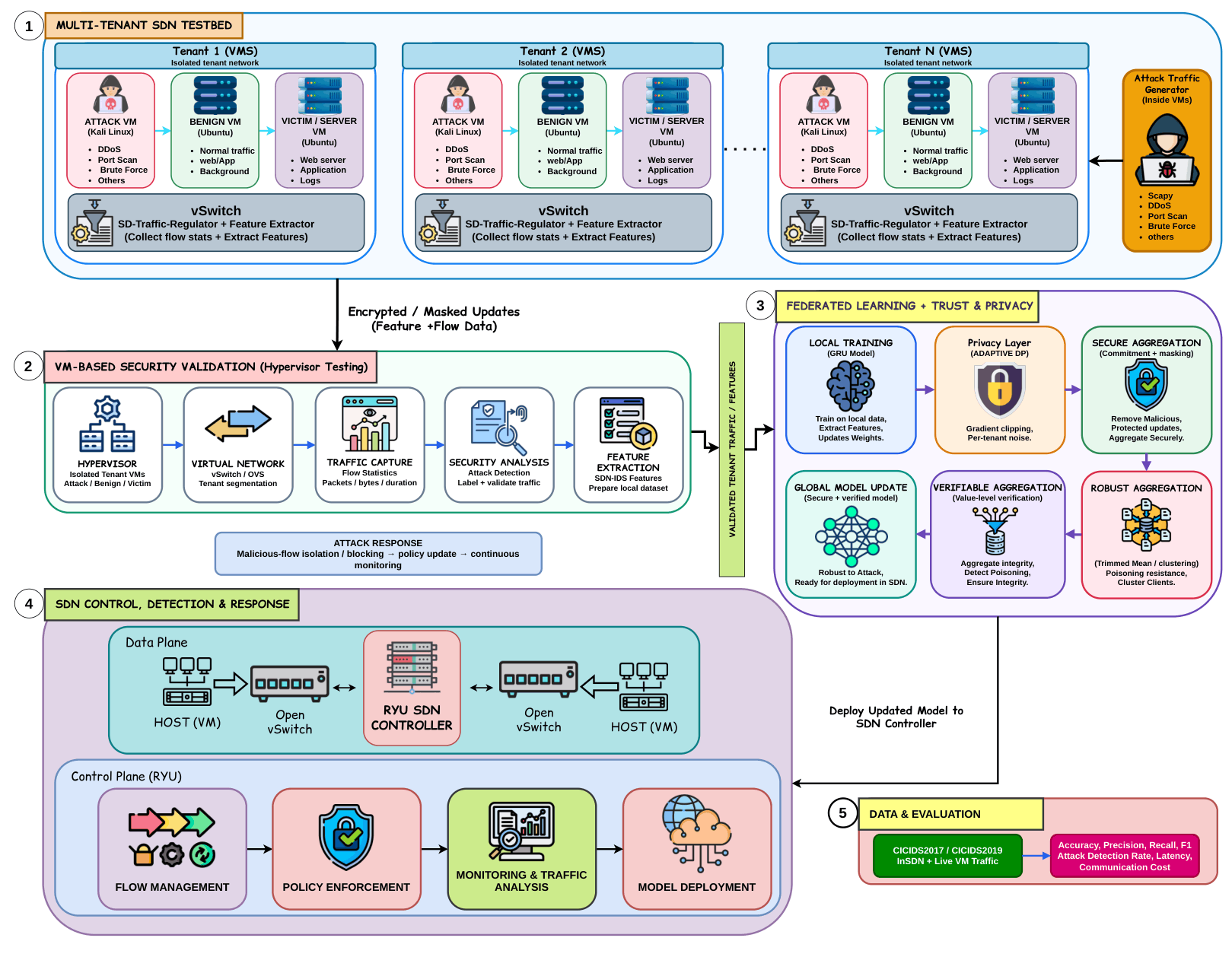
A multi-tenant SDN testbed feeding a federated learning and trust layer.
Each tenant runs an isolated set of virtual machines — an attack source, benign traffic, and a victim/server — behind its own vSwitch and RYU controller instance. Flow features extracted at the switch are trained locally with a GRU model, then passed through an adaptive differential-privacy layer before being committed, verified, and robustly aggregated into a single global model.
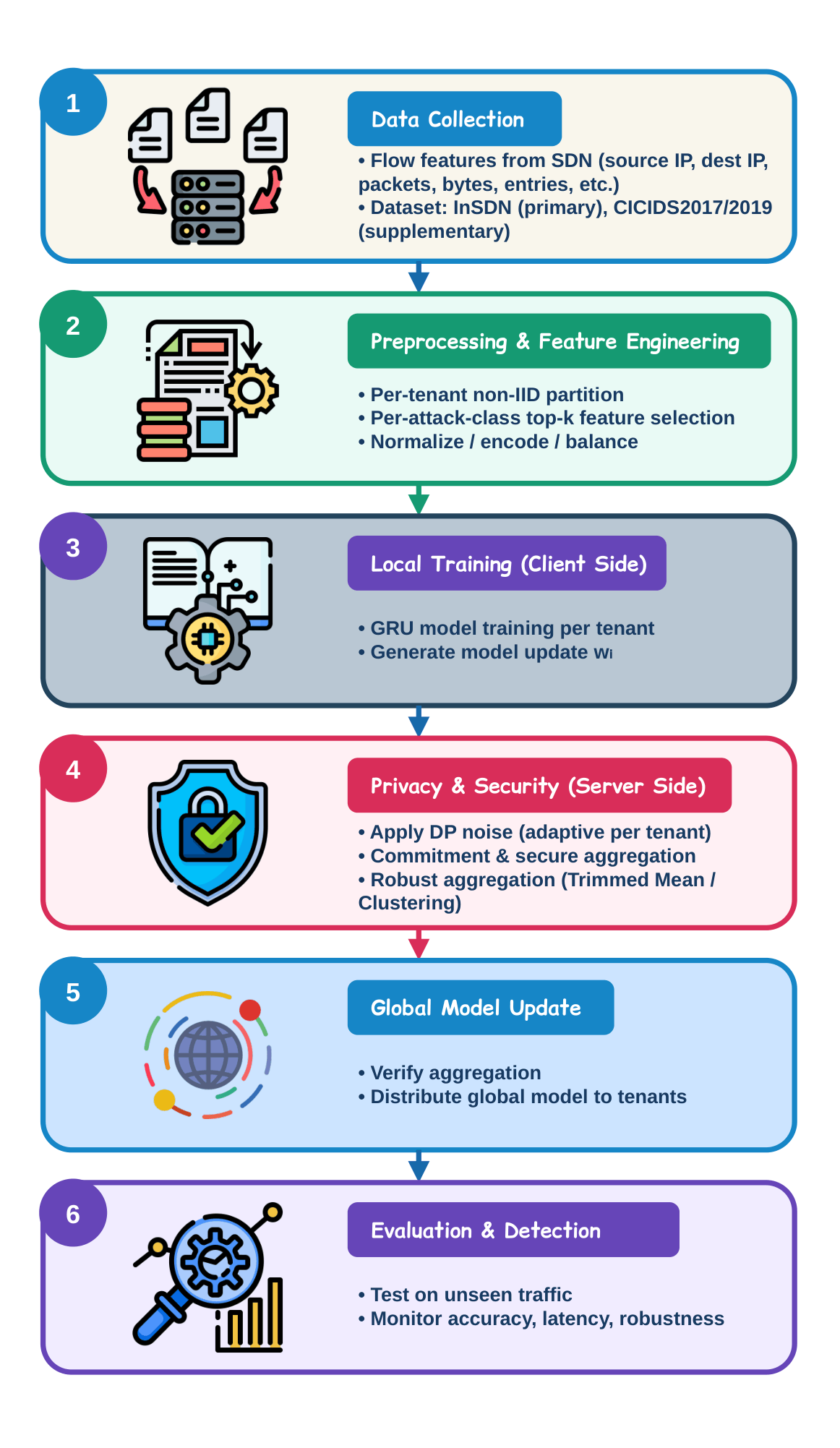
One federated round, from raw traffic to a deployed detector.
Every round moves through six stages: flow features are collected from each tenant's SDN switch, reduced to the most relevant per-attack-class features, trained locally on the client side, then privacy-noised and securely aggregated on the server side before the updated global model is verified and pushed back out for evaluation on unseen traffic.
The prior work TrustFed-SDN builds on and positions itself against. Select any entry to open its DOI.
The people behind TrustFed-SDN.
Student ID 2101005
Department of Internet of Things & Robotics Engineering, University of Frontier Technology, Bangladesh.
Student ID 2101042
Department of Internet of Things & Robotics Engineering, University of Frontier Technology, Bangladesh.
Lecturer, Department of IRE
University of Frontier Technology, Bangladesh — supervising this thesis project.